



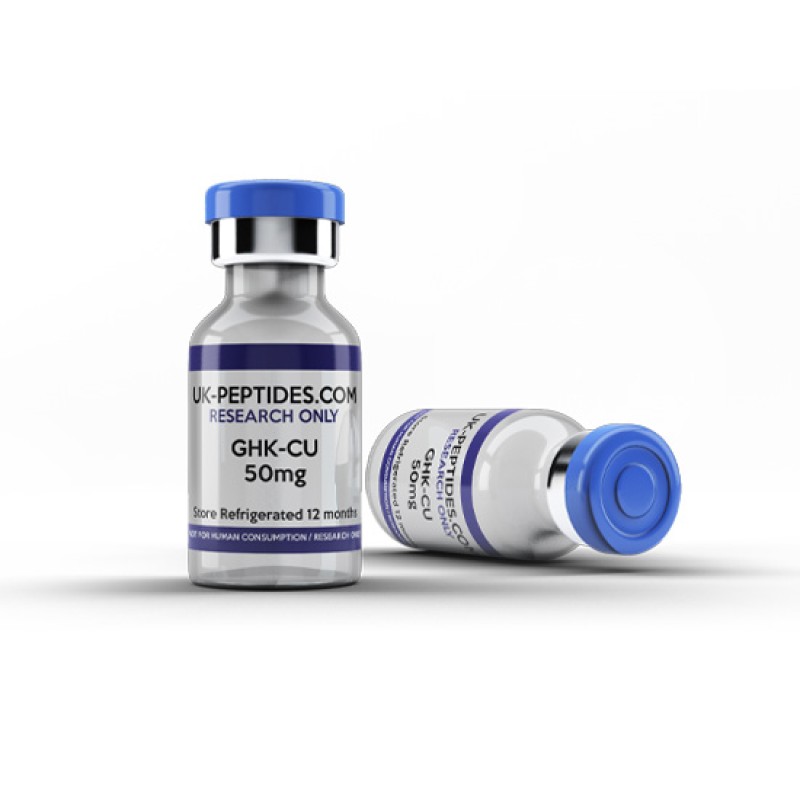
- Stock: 6561
- Model: GHK-Cu 50mg
- Molecular Formula: C14H21CuN6O4
- SKU: GHK-023
- Research Only: Yes
Certificate of analysis

GHK-Cu 50mg Copper Tripeptide Complex
GHK-Cu is the copper(II) complex of the tripeptide glycyl-L-histidyl-L-lysine. The free tripeptide was first described in human plasma in the early 1970s. In the presence of copper(II) it forms a stable coordination complex, and that complex is what we supply here, not the free peptide. The copper is what gives the lyophilised solid its blue colour.
Identity and specification
- Product name: GHK-Cu 50mg (Copper Peptide)
- Synonyms: Copper tripeptide-1, Prezatide copper, Cu-GHK, GHK copper
- CAS number (copper complex): 89030-95-5
- CAS number of the free tripeptide, for reference: 49557-75-7 (not the identifier for this product)
- PubChem CID: 165429100 for the neutral 1:1 complex, 71587328 for prezatide copper
- Molecular formula: C14H22CuN6O4 (neutral 1:1 complex)
- Molecular weight: 401.9 g/mol. The free tripeptide is 340.38 g/mol
- Peptide sequence: Gly-His-Lys
- Catalogue number: GHK-023
- Unit: 1 vial, 50mg
- Form: Lyophilised solid
- Purity: >99% by HPLC
Which identifier is correct, and why it matters
GHK and GHK-Cu get conflated across this market, including in supplier listings. They are two different materials. The free tripeptide carries CAS 49557-75-7 and a molecular weight of 340.38. The copper complex carries CAS 89030-95-5 and a molecular weight of roughly 402.
PubChem catalogues the complex in more than one form. The neutral 1:1 complex sits at 401.91, a cationic form at 402.92, and a 2:1 species at 744.3. Quoted masses therefore vary a little between sources depending on which is being described. What does not vary is the difference between complexed and uncomplexed material. Before comparing listings on mass or on price per milligram, confirm which of the two a supplier is quoting.
Appearance and batch colour variation
Colour ranges from deep blue to a lighter blue between batches. This is normal. It comes down to synthesis route, water content and storage conditions, and it is not an indicator of purity. We have supplied this compound for many years and the variation has been consistent across that period. Purity is measured by HPLC rather than inferred from how the vial looks.
Storage and stability
Supplied lyophilised. Store the sealed vial at -20°C, protected from light and moisture. Lyophilised material is the stable presentation. Once in solution, stability drops and is affected by temperature, light and the solvent used. Copper complexes are also sensitive to chelating agents and to strongly acidic or alkaline conditions, so buffer selection matters here in a way it does not for uncomplexed peptides. All handling and laboratory procedures are determined by the receiving laboratory under its own protocols.
Synthesis and quality control
Synthesised under controlled conditions and tested per batch. Identity and purity are established by reverse-phase HPLC. A purity figure quoted without a stated method is not comparable between suppliers, because the number depends on how it was measured.
Legal and safety information
UK Peptides supplies GHK-Cu strictly as a laboratory research chemical. It is not a medicine. It is not for human or veterinary use, and it is not for use in food or cosmetics. We do not provide preparation, handling or usage guidance, and we are unable to answer enquiries relating to human consumption.
Related pages
| Identification | |
| Molecular Weight (g/mol) | 401.9 g/mol |
| Peptide Sequence | Glycyl-L-histidyl-L-lysine |
| Physical and Chemical Properties | |
| Molecular Formula | C14H22CuN6O4 |
| Physical Appearance | Blue lyophilised solid |
| Form | Lyophilised (freeze-dried) solid |
| Solubility | Aqueous soluble |
| Appearance | Blue lyophilised solid |
| Melting Point | Not applicable (decomposes before melting) |
| Analytical and Quality Control | |
| HPLC Result | Shows min 99% Purity |
| Mass Spectrum | Consistent with structure |
| Purity % | >99% |
| Research Use and Safety | |
| Caution | Research use only / Not for human or veterinary use |
| Intended Use | For laboratory research use only. Not for human or veterinary use. |
| Hazard Classification | Not classified as hazardous under GHS for research quantities |
| Storage, Handling and Stability | |
| Storage Temperature, Opened | Lyophilized peptides although stable at room temperature for 3 months, should be stored desiccated below -18°C. Upon reconstitution of the peptide it should be stored at 4°C between 2-21 days and for future use below -18°C. |
| Storage Temperature, Unopened | -20 °C recommended for long-term storage |
| Shelf Life | 2 years unopened under recommended conditions |